Dano falls on the fifth day of the fifth lunar month, at the start of summer, after the rice has been planted. What does that mean for a day in Gangneung? The date shifts against the solar calendar, and the festival gathers several days of ceremony and public celebration around it. The result is not a neat appointment with one event, but a whole stretch of riverbank given over to the occasion.
Was this always just a Gangneung affair? No. Dano was once kept around Korea, with swings, wrestling and special foods marking the season. In most places it has dwindled to a date on the calendar. Gangneung took a different course: its Danoje has grown into the city’s largest event, lasting about a week and combining rites, performances and a fair on a scale that rather resists the idea of a quiet observance.
Gangneung
What is happening before the festival day begins? The rites have been building for weeks. Rice and yeast offered by local people are made into sacred wine. In the fourth lunar month, a procession goes west from the city to Daegwallyeong, the mountain pass, for ceremonies honouring the mountain spirit and a guardian deity linked to a revered monk of the Silla period. The deity is then invited down, brought towards the city with a sacred tree branch and enshrined for the festival. A fair can be assembled in a hurry; this part of Danoje has a longer run-up.
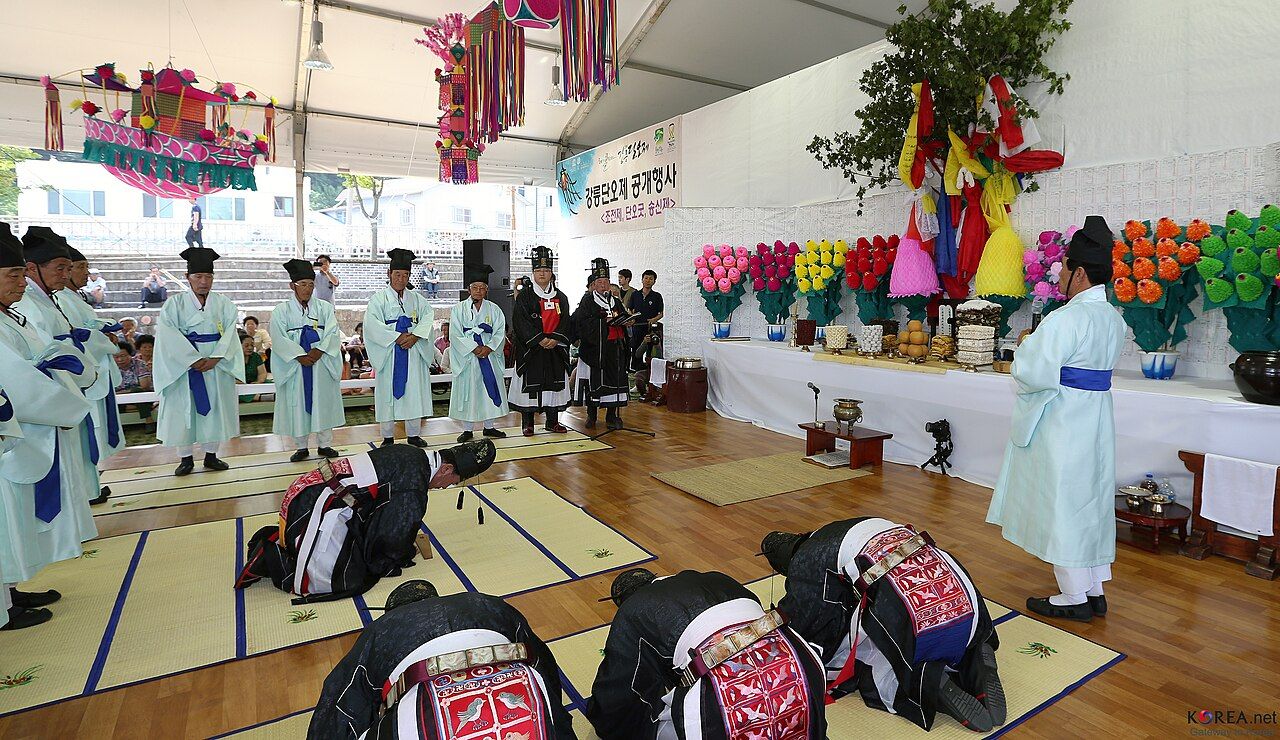
What greets the morning by the river? Ceremonies follow Confucian order, with officiants in long robes and black hats making offerings and bowing before an altar. Nearby, female shamans perform Danogut inside a tent set aside for the rites. It is a long sequence of music, dance and song, and can carry on for hours. Visitors may sit at the back and watch. For some participants this is a living religious event; for everyone else it is a public celebration taking place alongside it. The distinction is not difficult to see, though a crowded festival has its own ideas about personal space.
Does the ceremony finish with the crowd? Not yet. At the end of the festival, a final rite sends the deity back to the mountain, and ritual objects are burned. The welcome and the farewell make a frame around the days in between.
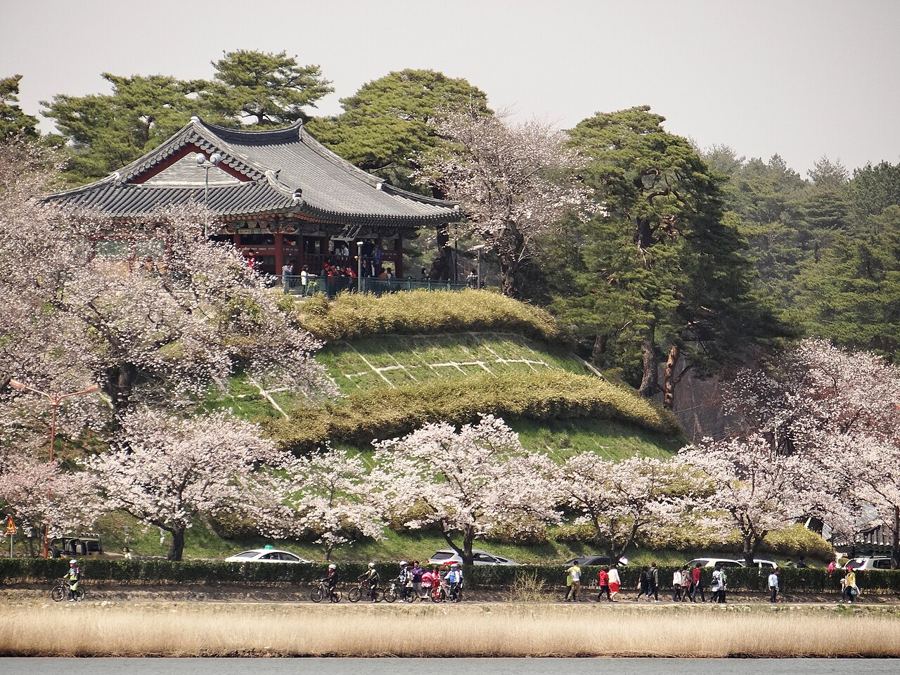
As the day moves on, the grounds along Namdaecheon fill out. The river runs through the south of central Gangneung, and the open area known as Danojang holds the main stages and ritual tent. The date’s drift through late spring and early summer is part of the story too; the account of seasons on the coast follows that broader turn of the year. Danoje itself has an older calendar, which is not especially interested in keeping a fixed date on the modern one.
What takes the stage after the rites? Gwanno mask drama, once performed by servants of the local government office. Uniquely among Korean mask plays it has no spoken dialogue. Dance and gesture carry a story involving a nobleman and a young woman, two comic figures wearing fierce masks, and a pair of characters dancing to drive away bad luck. It is short, funny and easy to follow without Korean. The silence is doing useful work; nobody needs to pretend to understand a speech.
Uniquely among Korean mask plays it has no spoken dialogue.
What else occupies the open ground? Ssireum, Korean wrestling, takes place in a sand ring. Competitors hold a cloth band tied around an opponent’s thigh and waist, an arrangement that makes the contest look less like a simple test of strength and more like a problem with several possible solutions. Geune is the high swinging contest, traditionally a women’s Dano game; the aim is to swing highest, and the contest still draws a crowd. There is also tug-of-war, traditional music and dance, and folk performances from other regions.
Next stop: Ojukheon, from black bamboo to the banknotes City
Are these customs only for watching? Some are presented in forms visitors can try. Hair was washed in water steeped with iris leaves, or changpo, in the belief that it warded off illness and made hair shine. Fans were given as the hot season began. The traditional festival rice cake is round, marked with a wheel pattern and coloured with a mountain herb. The selection of customs on offer varies, but the old ideas behind them are more than decorative extras: they belong to the season Dano marks.
Namdaecheon
What happens as evening arrives? Around the ritual tent and stages, the nanjang fair spreads across the riverbank: food tents, stalls, games and rides. Local families spend their evenings there, eating grilled food and buying sweets beneath strings of lanterns. The fair is among the largest of its kind in Korea. On weekend evenings it can become shoulder to shoulder, which is one way of making a public celebration feel very public indeed.
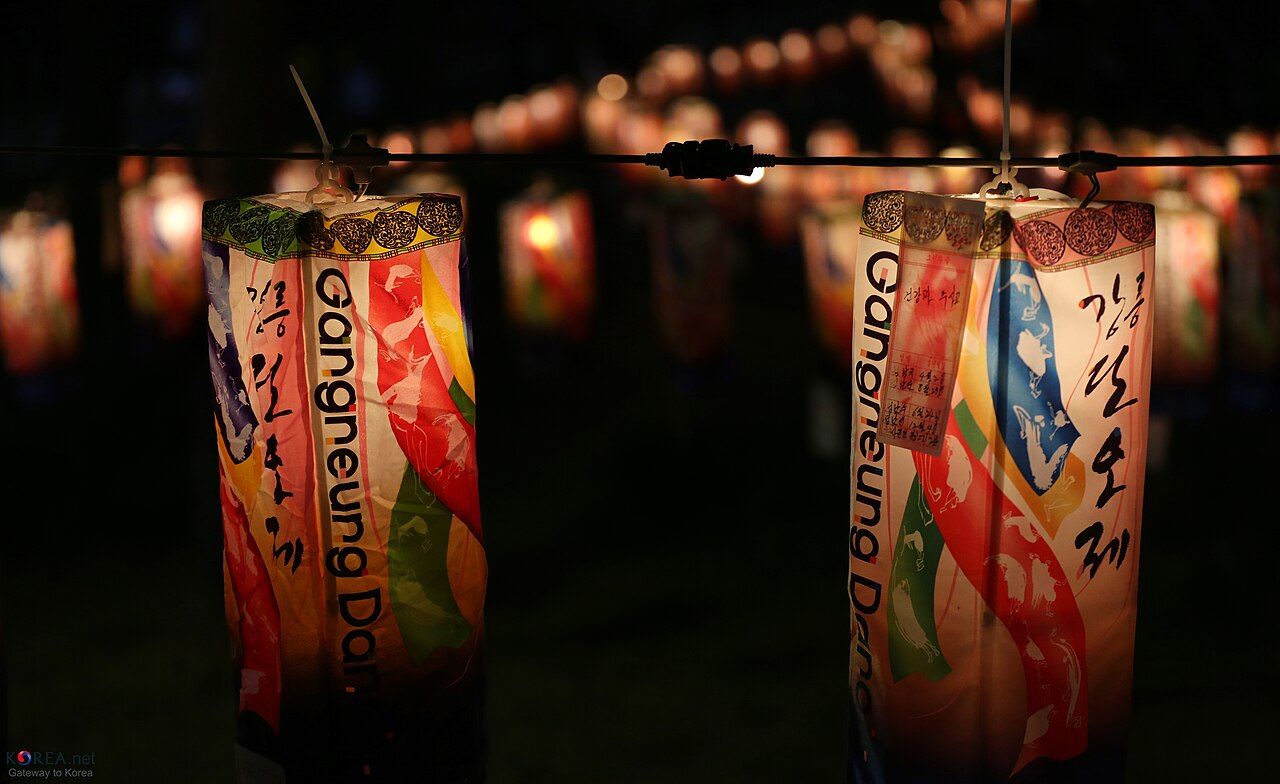
Does the day become solemn again after dark? Not exactly. Lanterns glow above the grounds while the fair carries on, and the religious rites and cheerful crowds remain parts of the same festival. There is no need to decide that one cancels out the other. Danoje has room for both, and for the occasional queue formed by people who have come to observe old customs and are now considering sweets.
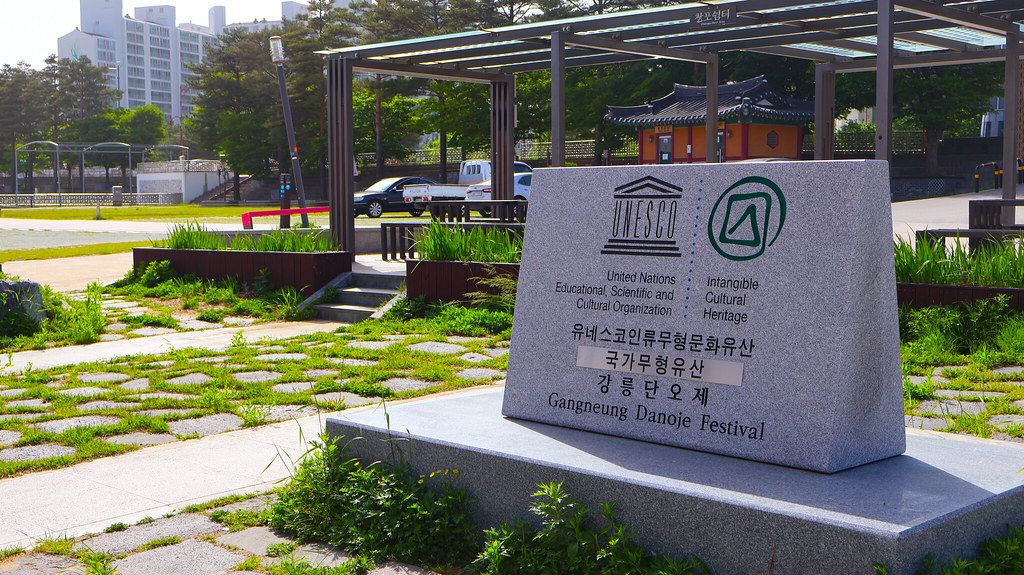
Why is the festival recognised beyond Gangneung? UNESCO named Gangneung Danoje a masterpiece of oral and intangible heritage in 2005; it was later placed on the organisation’s Representative List. Korea also protects it as national intangible heritage. Those distinctions are substantial, but the riverbank is not made solemn by them. The same event holds rites, wrestling, food and a fair, without asking any of them to disguise themselves as something else.
What remains for someone visiting outside festival week? The riverbank returns to open ground, and the city has a centre near the river devoted to Danoje, with displays on its rites, masks and music. Ojukheon’s city museum also covers regional folk traditions. For the town’s everyday centre, even Jungang Market belongs to the same wider map; the festival grounds can be reached on foot from there. The journey into Gangneung is another story, told in getting to Gangneung. And for a closer look at the traditions that outlast the lanterns, the story of Ojukheon is a good next turn.
Credits: Mobius6; Creative Commons BY-SA 4.0; Christophe95; Creative Commons BY-SA 4.0; Scroozle; Creative Commons BY-SA 3.0